
By David Schneer
6-Minute Read
Warnings of impending doom and false prophets are as old as time itself. Scripture abounds with admonitions against false prophets, from the Old Testament (e.g., Deuteronomy 13:1-3; Jeremiah 23:16) to the New Testament (e.g., Matthew 7:15; 2 Peter 2:1).
Just as ancient “seers” foretold events that never transpired, today’s technology pundits often succumb to a secular, yet similar, fate—proclaiming the end is near, only for time to prove them wrong. The latest wave of alarm centers on artificial intelligence (AI) and its potential to replace humans entirely. It seems the sky is falling on a pack of crying wolves.
Before diving into whether AI will truly upend the human workforce, let’s revisit history and examine a few memorable predictions that fell flat.
1940s-1950s: Semiconductors’ Limited Future
In the early days of semiconductors, skeptics dismissed their potential, relegating them to low-tech applications like hearing aids and basic amplifiers. Yet by the 1960s, semiconductors had laid the groundwork for transistors, integrated circuits, and microprocessors—revolutionizing computing, communications, and consumer electronics.
Around the same time, IBM Chairman Thomas Watson Sr. allegedly claimed, “I think there is a world market for maybe five computers.” Meanwhile, “Popular Mechanics” predicted future computers would weigh no more than 1.5 tons. By the 1970s, the personal computing revolution was underway, making such forecasts laughably obsolete.
1970s and Beyond: Moore’s Law and Its “Imminent End”
For decades, experts have predicted the demise of Moore’s Law, which observes that the number of transistors on a chip doubles approximately every two years. Although technological and physical challenges have grown, innovations like FinFET and EUV lithography have kept Moore’s Law alive, albeit at a slower pace.
1999: Y2K and the Fear of Global Meltdown
As the year 2000 approached, widespread panic erupted over the so-called Y2K bug, with fears that computer systems worldwide would fail due to date representation errors. Thanks to the extensive work of programmers, the predicted chaos never materialized, leaving only minor glitches in its wake.
Early 2000s: The Dot-Com Bust and Silicon Valley’s “End”
After the Dot-Com Bubble burst, many declared Silicon Valley’s dominance dead. Instead, the tech industry rebounded stronger than ever, with giants like Google, Apple, and Facebook leading a new era of innovation.
2000s-Present: The “Death” of Silicon Chips
Predictions about the demise of silicon chips in favor of alternative materials like graphene or quantum computing have persisted for over two decades. While new materials show promise, silicon remains the backbone of semiconductor manufacturing due to its scalability and cost-effectiveness.
2007: “Smartphones Will Fail”
When Apple launched the first iPhone, critics scoffed at the idea of an all-in-one phone, camera, and media player. Microsoft’s Steve Ballmer famously laughed it off, claiming it wouldn’t appeal to business users. Fast-forward to today and smartphones have become indispensable, revolutionizing communication, commerce, and entertainment
Mid-2000s: Cloud Computing Skepticism
Industry leaders doubted businesses would embrace cloud-based storage and services due to security and reliability concerns. Yet today, providers like Amazon Web Services, Microsoft Azure, and Google Cloud have made cloud computing the foundation of modern infrastructure.
The AI Fear: Will Robots Replace Us?
And now, AI has taken center stage as the latest technological boogeyman. Many wonder: Will AI replace humans? My answer, and that of Andrew Ng’s: no—but someone who knows how to use it will.
In Chapter 7 of my book, “BACKBONE: Surviving the Road Less Quantified; Toward a Deeper Understanding of Qualitative Research,” I discuss how AI can complement human intelligence in research rather than replace it. Here’s an excerpt:
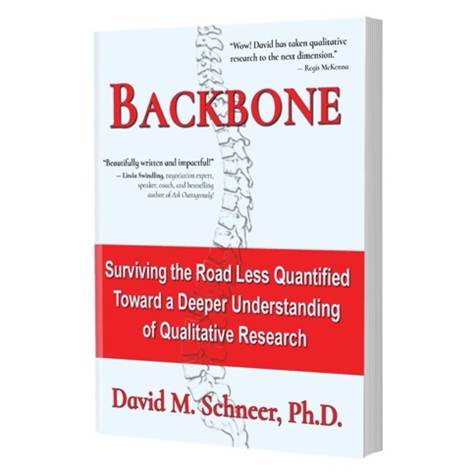
“Our qualitative research combines the best of both worlds—human nonverbal intelligence interpretation backed by AI. While we carefully considered the warnings about AI, we concluded that the benefits outweighed the risks and moved forward. Occasionally, I wondered: Could AI replace me or other moderators? Not anytime soon. When that day comes, I’ll be fertilizer.
Even if robots could conduct interviews, who would want to be questioned by a machine? Sounds like a bad date. Would people confide in a robot the way they do with a human? Probably not. And even if they did, would the robot truly understand—or care?
Human relationships are built on trust and rapport, qualities unlikely to be mastered by even the most advanced AI. Humans excel at adapting to changing circumstances and recognizing the subtle nuances of communication. Emotional intelligence, discretion, empathy, and compassion remain uniquely human traits. In these areas, robots simply can’t compete.”
Conclusion
From dismissing the potential of semiconductors to fearing global meltdowns, history teaches us that technological innovation often defies even the direst predictions. The future is rarely as limited—or catastrophic—as some would have us believe.